
|
|
|
|
-
How can I minimise my risk of getting melanoma and other types of skin cancer?
-
Which sunscreen should I use?
-
What is the difference between UVB and UVA?
-
What does ‘SPF’ mean?
-
What SPF factor should I be using?
-
How often should you apply sunscreen and when?
-
How can I avoid overexposure to UV?
-
Do more expensive sunscreens provide better protection?
-
Do I need to be concerned about nanoparticles?
-
What can I do to minimise my risk of melanoma if I do get sunburned?
-
How can I make sure I get enough Vitamin D?
-
Does the use of sunscreens reduce the production of Vitamin D?
1. How can I minimise my risk of melanoma and other forms of skin cancer?
The simplest and most effective way to reduce your chance of developing melanoma and other types of skin cancer is to protect your skin from the sun.
-
Seek shade; sun can reflect off surfaces such as water, sand and concrete causing sunburn
-
Wear clothing that covers at least your back, shoulders, arms and legs
-
Wear a broad brimmed hat
-
Wear wrap-around sunglasses to protect both your eyes and the delicate skin around your eyelids
-
Apply a broad-spectrum sunscreen, with SPF of at least 30+, every 2 hours.
There is also some evidence that a healthy, low fat diet and stopping smoking are other ways to help lower your skin cancer risk. Sunbeds increase the risk of melanoma, so avoid them completely.
2. Which sunscreen should I use?
We recommend using a broad spectrum sunscreen (one which protects against both UVA and UVB rays) with a minimum SPF rating of 30+.
3. What is the difference between UVB and UVA?
UVB radiation is the primary cause of sunburn, and also causes skin cancer and premature ageing. UVB is most intense at midday when sunlight is brightest.
UVA radiation penetrates the skin’s layers more deeply than UVB, but is only a very minor contributor to sunburn. Like UVB, UVA can also cause premature ageing and damage to genetic material in skin cells (mutations) and can suppress the skin’s immune system- effects which increase risk of skin cancer. Unlike UVB, UVA can pass through window glass.
4. What does ‘SPF’ mean?
The Sun Protection Factor is a measure of how well a sunscreen prevents sunburn in human volunteers in a laboratory setting. SPF is a very useful way to rank the level of sunburn protection offered by different products, but it does not tell us how long a person can safely be exposed to natural sunlight. Sunscreens should be used in combination with sun-safe behaviours, clothing and hats and should not be used in order to prolong sun exposure.
5. What SPF factor should I be using?
The higher the SPF, the less UV will reach your skin during a given amount of sun exposure. Even small amounts of UV radiation, well below the sunburn threshold, can cause damage to the skin. Although an SPF 50+ product (which must have a measured SPF of at least 60) will in theory protect twice as well as an SPF 30 product, sunscreens can only reduce, but not completely block, UV rays.
6. How often should you apply sunscreen and when?
Every 2 hours, and after swimming and exercise.
7. How can I avoid overexposure to UV?
Seek shade or stay indoors during the hottest part of the day (10am-2pm or 11am-3pm during summer). Find out the UV index in your area.
8. Do more expensive sunscreens provide better protection?
Not necessarily. Providing a sunscreen is broad spectrum and has a SPF rating of at least 30+, it should provide sufficient protection when used sensibly, together with other sun-protective behaviours. There are a wide range of products available for dry or oily (acne-prone) skin, sensitive or normal skin.
9. Do I need to be concerned about nanoparticles?
Although there is no evidence that nanoparticle formulations of sunscreens are harmful, the nanoparticle ingredients are not in any case able to penetrate normal skin. Instead, they remain limited to the dead outer layer of the skin (the stratum corneum). In contrast, we know that even small amounts of UV radiation are carcinogenic (able to cause cancer).
10. What can I do to minimise my risk of melanoma if I do get sunburned?
The only way to minimise risk is to avoid getting burned. Proper use of shade, clothing, hats and sunscreens makes sunburn very easy to avoid. If you do get sunburnt, drink water to avoid dehydration. Avoid the use of potentially irritant creams or moisturisers containing fragrances or preservatives and consider using a bland ointment such as Vaseline or emulsifying ointment. If you have severe sunburn or blisters, see your doctor as anti-inflammatory ointments or tablets may be needed.
11. How can I make sure I get enough vitamin D?
Exposure to UVB radiation in sunlight provides the mechanism for more than 90% of vitamin D production in Australians. Most people will get enough vitamin D through daily outdoor activities and foods containing vitamin D. Minimum exposure of about 15% of the skin either side of the peak UV period (10am-2pm or 11am-3pm daylight saving time) will assist in maintaining vitamin D levels. Ideally, you should still protect your face with sunscreen all year round as this is an area particularly susceptible to sunspots (keratoses) and skin cancers. If you are unsure about whether you’re getting enough vitamin D, see your doctor.
12. Does the use of sunscreens reduce the production of vitamin D?
Normal use of sunscreens, in combination with a healthy active lifestyle, does not generally result in vitamin D deficiency.
Australia has the highest incidence of melanoma in the world and melanoma is often referred to as Australia's national cancer. Here are some other facts and statistics about melanoma, the most serious form of skin cancer.
At a glance
-
Melanoma is the third most common form of cancer in Australian men and women (10% of all cancers)
-
More than 11,000 new cases of melanoma are diagnosed in Australia every year
-
Melanoma makes up only 2.3% of all skin cancers but is responsible for 75% of skin cancer deaths.
-
The good news is that melanoma is often identifiable at an early stage where simple treatment can result in complete cure.
Melanoma is Australia’s national cancer
-
Australia has the highest incidence of melanoma in the world.
-
Melanoma rates have doubled in the 20 years from 1986-2006.
-
Melanoma rates are still on the rise with an estimated 392 extra cases per year.
-
1 in 19 Australians will be diagnosed with melanoma before age 85.
Melanoma is the most common cancer in young Australians
-
Melanoma is the most common cancer in young Australians aged 15–44 years old.
-
In this age group, melanoma makes up 20% of all cancer cases and is responsible for 8% of all cancer deaths.
-
In 20–34 year-olds, melanoma kills more young Australians than any other single cancer.
Melanoma can kill you
-
In 2007, 1,279 Australians died from melanoma.
-
Melanoma makes up only 2.3% of all skin cancers but is responsible for 75% of skin cancer deaths.
-
Melanoma was responsible for 3.2% of all cancer deaths in Australia in 2007.
Melanoma affects men more than women
-
Females risk to age 85 = 1 in 24.
-
Males risk to age 85 = 1 in 15.
-
Twice as many men as women die from melanoma each year.
Sources
AIHW 2010. Cancer in Australia 2010: an overview. Cancer series no. 60. Cat. no. CAN 56. Canberra: AIHW.
AIHW 2010. Australia's health 2010. Australia's health no. 12. Cat. no. AUS 122. Canberra: AIHW.
When sunlight penetrates the top layers of the skin, ultraviolet radiation (referred to as UVA or UVB) bombards the genetic material, the DNA, inside the skin cells and damages it.
UVB radiation is the primary cause of sunburn and primarily affects the skin’s outer layers. UVB is most intense at midday when sunlight is brightest. It is interesting to note that slightly more than 70% of the yearly UVB dose is received during summer and only 28% is received during the remainder of the year.
On the other hand, UVA radiation penetrates more deeply and efficiently; however, UVA's intensity also tends to be less variable both during the day and throughout the year than UVB's. For example, only about half of the yearly UVA dose is received during the summer months and the balance is spread over the rest of the year. UVA is also not filtered through window glass (as is UVB).
Damaging effects of UV radiation
Both UVA and UVB rays damage the skin, inducing genetic injury, wrinkles, lower immunity against infection, aging skin disorders and cancer, although the reasons for this are not yet fully understood. Find out the UV index in your area. The following are some ways in which cancer may develop and some defensive actions that the skin uses to protect itself against DNA damage.
Oxidation and antioxidants
UV radiation affects the production of oxidants, also called free radicals. These free radicals are unstable molecules produced by normal chemical processes in the body that, in excess, can damage the body's cells and even alter their genetic material, contributing to the aging process and sometimes to cancer. The large surface area of the skin makes this organ a prime target for oxidants.
Defective DNA repair and protective enzymes
Some melanomas and other skin cancers are caused by a breakdown in the mechanisms that help repair DNA damage. This can occur due to various causes including an inherited condition called xeroderma pigmentosum (XP). A number of enzymes in the skin help protect against this damage. One repair enzyme called T4 endonuclease 5 (T4N5) is, in fact, being investigated in lotions to protect against skin cancers.
Breakdown of Immune Protection
Specific immune factors protect the skin, including white blood cells called T lymphocytes and specialized skin cells called Langerhans cells. These immune factors attack developing cancer cells at the earliest stages. Unfortunately, certain substances in the skin, in particular a chemical called urocanic acid, suppresses these immune factors when exposed to sunlight, setting the stage for skin cancers.
Defective Cell Death (Apoptosis)
Apoptosis is the last defense of the immune system. It is a natural process of cell-suicide, which occurs when cells are severely damaged. Apoptosis in the skin kills off cells harmed by UVA preventing them from becoming cancerous. (The peeling after sunburn is the result of these dead skin cells.) In some cases, however, genetic mutations or other factors derail apoptosis. If this occurs, the cells can become immortal and continue to proliferate, resulting in skin cancers.
Melanoma
Melanoma is a malignant cancer that starts from the pigment cells (melanocytes) of the skin. These cells are the cause of freckles and moles on the skin and produce the brown colour of a suntan.
Melanoma can occur anywhere on the skin, even on the soles of the feet. Melanocytes in the eye, nervous system and mucous membranes(eg lining of the mouth and nasal passages) can also become cancerous. These types of melanoma are rare.
Melanoma grows quickly. If it is not treated, it may spread to the lower layer of skin, where cancer cells can escape and be carried to other parts of the body in blood or lymph vessels.
In particular, it is of great importance to Australians for two main reasons:
-
Australia has the highest incidence of melanoma in the world
-
It is often identifiable at a stage when simple treatment can result in complete cure
Dr Neville Davis is a Queensland surgeon with vast experience in the treatment of melanoma. He wrote, "Malignant melanoma writes its message in the skin with its own ink and it is there for all of us to see. Some see but do not comprehend."
The Skin
The skin has many important jobs. It protects us from injury, cools us when we get hot and prevents us from becoming dehydrated. The skin has two main layers: the epidermis and the dermis.
The epidermis is the top or outer layer. It contains two main types of cells: squamous cells and melanocytes. The melanocytes produce melanin, the substance that gives skin its colour. When skin is exposed to sunlight, the melanocytes produce more melanin and the skin becomes tanned.
The dermis is underneath the epidermis. It contains the roots of hairs, glands that make sweat and oil, blood and lymph vessels and nerves.
Melanocytes
Melanocytes (pigment cells) are found distributed in the skin:
-
Scattered as individual cells at the junction of the upper (epidermis) and lower (dermis) layers of the skin. These cells produce granules of pigment in response to sunlight (a suntan).
-
Aggregated together (in groups termed naevus cells) at various depths within the epidermis and dermis.
Characteristic patterns of aggregation can usually be recognised by expert clinicians as those forming moles:junctional, dermal, compound and dysplastic naevi. The word ‘mole’ is an old English description which originally referred to dark hairy patches on the skin (congenital naevi) which were likened to the soil burrowing animals. The term ‘mole’ has since been used more broadly and as such is not clinically used.
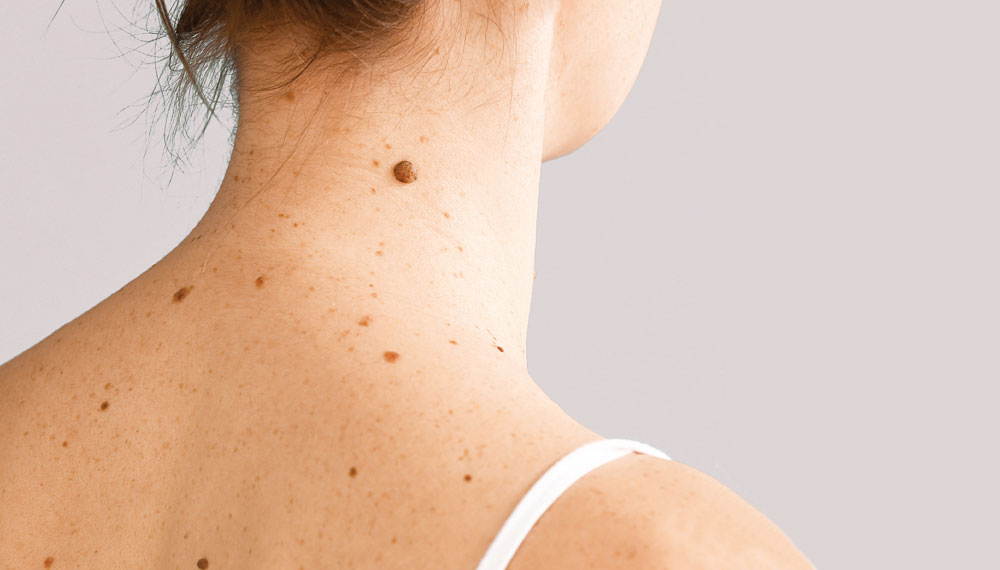
It is important to note that melanoma can develop in the scattered melanocytes in plain skin or may be associated with pre-existing pigmented naevi (moles).
Moles and Melanoma
Melanocytes and naevus cells do not normally group together to form naevi (moles) until after the first few years of life. Occasionally children are born with pigmented birth marks (congenital naevi).
However, most naevi (moles) are acquired from the age of 5 up to 20 years. During this time new naevi develop and others change, but usually in some proportion to other naevi and overall body growth.
The development of new naevi (moles) or change in existing ones, especially of single naevi after adolescence is significant and we recommend seeking medical advice.
A number of genetic factors are being investigated for their role in melanomas, including inherited genes and genetic defects that are acquired from environmental causes (particularly sunlight).
Mutations in Genes
Non-inherited mutations in a number of genes that inhibit tumour growth or other cell-protecting properties may account for cancerous changes in moles and for aggressive melanomas. The following are some examples.
-
Important studies have now identified a mutation in the BRAF gene that appears to be the most common event in the process that leads to melanoma. Some researchers have observed mutations in 66% of melanomas. Researchers hope that agents that block this gene may provide a viable treatment option.
-
P16 is a tumour suppressive gene that may be abnormal in some melanoma cases.
-
CDKN2A Mutations. Mutations in a genetic regulator called CDKN2A are the most common causes of inherited melanoma (which accounts for only a small proportion of melanoma patients). Mutations in this gene also appear in non-inherited cases of melanoma. Genetic tests are being developed for CDKN2A.
|
|
|
|
|
|